


GLDA Wastewater Treatment: A Practical Way to Improve Fenton Efficiency
Release time: 2026-05-06
In the field of traditional wastewater treatment, the Fenton process is widely used to remove persistent organic pollutants. However, it typically requires strongly acidic conditions and often suffers from low iron cycling efficiency.
A growing alternative is the use of Tetrasodium Glutamate Diacetate (GLDA,GLDA-4Na) CAS 51981-21-6 to enhance Fenton reactions, enabling effective treatment under neutral pH conditions. This method is garnering increasing attention within the industry, as it strikes an excellent balance among processing efficiency, cost control, and environmental compatibility.
Công ty TNHH Hóa chất BLi-T (Hợp Phì) supplies GLDA,GLDA-4Na CAS 51981-21-6 for industrial and environmental applications, including advanced oxidation processes in wastewater treatment.
Why Does the Traditional Fenton Process Have Limitations?
The conventional Fe²⁺/H₂O₂ Fenton system works efficiently only at pH 2–4, which creates several practical challenges:
- Additional cost for acidification and neutralization
- Iron precipitation under neutral conditions
- Reduced catalytic efficiency due to slow Fe³⁺/Fe²⁺ cycling
These limitations make it less suitable for treating real industrial wastewater, which is often near neutral pH.
How GLDA Improves Wastewater Treatment Performance
BLiT’s GLDA acts as a biodegradable chelating agent that forms stable complexes with Fe³⁺ ions. This directly addresses the key bottlenecks of the Fenton process.
Stabilizing Iron at Neutral pH
GLDA binds with Fe³⁺ to prevent precipitation, allowing the reaction to proceed efficiently without adjusting pH.
Enhancing Iron Redox Cycling
The Fe³⁺–GLDA complex promotes faster conversion between Fe³⁺ and Fe²⁺, which is essential for continuous hydroxyl radical production.
Increasing Oxidant Utilization
With improved iron cycling, hydrogen peroxide is used more effectively, reducing overall chemical consumption.
System Performance Under Neutral Conditions
Studies based on antibiotic pollutants such as ciprofloxacin (CIP) show that GLDA-enhanced systems perform effectively at pH ≈ 7.
- Fe³⁺/GLDA/H₂O₂ system
Achieves up to 95%+ degradation efficiency under optimized conditions
- Visible light-assisted photo-Fenton system
Further improves removal efficiency to nearly 98%, while significantly reducing H₂O₂ dosage
This makes GLDA particularly suitable for advanced oxidation processes (AOPs) in real wastewater scenarios.
Mechanism: Why GLDA-Based Systems Work Better
The improved performance is driven by a combination of chemical and photochemical effects:
- Hydroxyl radicals (·OH) act as the primary oxidants for pollutant degradation
- Superoxide radicals (O₂·⁻) assist in regenerating Fe²⁺ from Fe³⁺
- The Fe³⁺–GLDA complex enables a more stable and continuous catalytic cycle
Together, these factors lead to faster and more complete degradation of organic contaminants.
Key Advantages for Industrial Wastewater Treatment
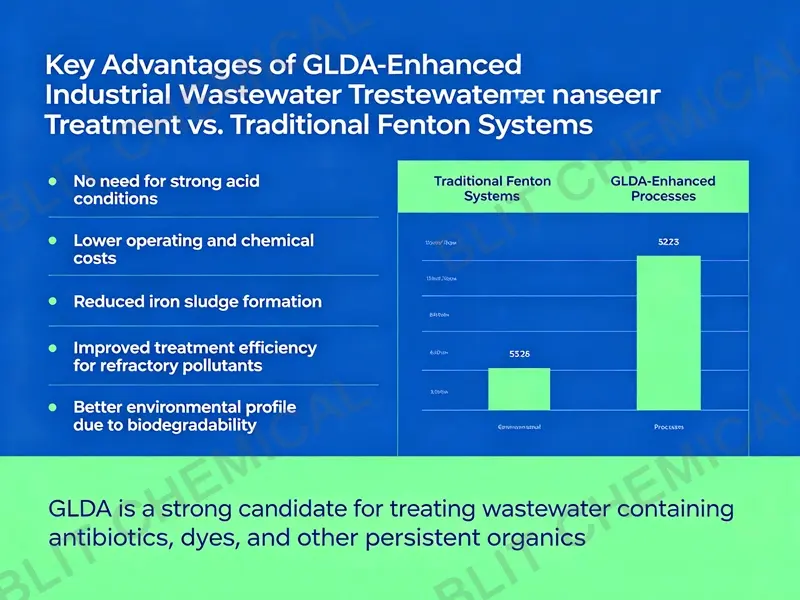
Compared with traditional Fenton systems, GLDA-enhanced processes offer several practical benefits:
- No need for strong acid conditions
- Lower operating and chemical costs
- Reduced iron sludge formation
- Improved treatment efficiency for refractory pollutants
- Better environmental profile due to biodegradability
These advantages make GLDA a strong candidate for treating wastewater containing antibiotics, dyes, and other persistent organics.
Application Potential
GLDA-based Fenton systems are particularly suitable for:
- Pharmaceutical wastewater treatment
- Chemical manufacturing effluents
- Textile and dye wastewater
- Industrial wastewater with neutral or weakly alkaline pH
As regulations tighten and sustainability becomes more important, solutions that combine efficiency and environmental compatibility are increasingly preferred.
FAQs About GLDA in Wastewater Treatment
1. Can GLDA completely replace traditional Fenton processes?
GLDA does not replace Fenton chemistry itself but enhances it. By enabling operation at neutral pH and improving iron cycling, it makes the process more practical for real wastewater treatment systems.
2. Is GLDA safe for environmental applications?
Yes, GLDA is considered a biodegradable and environmentally compatible chelating agent, often derived from natural raw materials, making it suitable for sustainable treatment processes.
3. How do I choose the right dosage of GLDA in treatment systems?
The optimal dosage depends on factors such as pollutant concentration, iron levels, and system design. Lab-scale or pilot testing is usually recommended to determine the best ratio for specific wastewater conditions.
To buy Tetrasodium Glutamate Diacetate (GLDA,GLDA-4Na) CAS 51981-21-6 from manufacturer in China, BLIT Chemical offers competitive price with full product support, including specifications, MSDS, TDS, and COA. For factory-price Tetrasodium Glutamate Diacetate(GLDA,GLDA-4Na), contact info@blitchem.com.