

D-Panthenol CAS 81-13-0 in Cosmetic Formulations: Guidance and Data
Release time: 2026-04-30
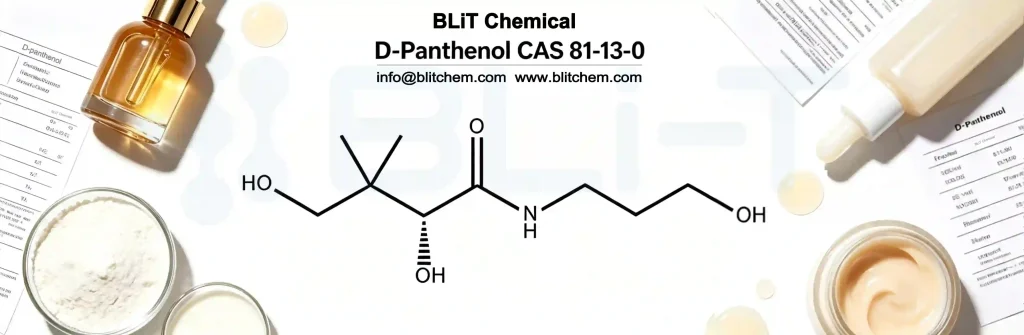
D-Panthenol (provitamin B5,cas 81-13-0) is a highly water-soluble, hygroscopic alcohol derivative of pantothenic acid, used broadly as a moisturizer, skin conditioner, and hair care agent. In cosmetic formulations, it is effective at low-to-moderate usage levels (typically 0.5–5% in leave-on creams, 0.1–5% in hair products) where it enhances hydration, barrier repair, and hair luster.
D-Panthenol is stable under normal cosmetic conditions – it remains intact under light and heat exposure and in acidic media – but degrades in strong alkaline or oxidative environments. It readily dissolves in water and glycols (ethanol, propylene glycol) and is incompatible with anhydrous oil phases.
It is generally recommended to incorporate broad-spectrum preservatives and chelating agents (such as phenoxyethanol and EDTA) into cosmetic formulations to inhibit microbial proliferation and chelate trace metal ions. When used within appropriate concentration ranges, D-Panthenol is typically non-irritating and non-sensitizing, with very few reported instances of contact allergic reactions. This ingredient has received global regulatory approval for use (including in markets such as the EU and the US), and in cosmetic applications, there are generally no strict upper limits established for its maximum inclusion concentration.
BLiT Chemical provides high-quality cosmetic grade75%/98%D-Panthenol and DL- Panthenol(USP/cosmetic grade) with full technical support for formulation, stability, and regulatory compliance.
Furthermore, through this guide, we aim to provide cosmetic formulators and manufacturers with professional technical data, recommended usage levels, compatibility information, safety assessments, and practical advice on formulation development regarding D-Panthenol.
Methods and Sources: This report is based on a review of technical datasheets (e.g. BASF/SkinIdent), regulatory listings, safety reviews (CIR), and recent literature (2014–2025). Key data on solubility, stability, and formulation use were extracted from supplier manuals and analytical studies. Safety and regulatory status were confirmed via cosmetic regulations (US FDA, EU CosIng) and patch test reports.
Formulation Use Cases, Concentrations, and Compatibility
D-Panthenol is used in a variety of cosmetic products. It is typically incorporated into the water phase of formulations due to its high hydrophilicity. The recommended addition level varies depending on the product type.
- Creams & Lotions (Leave-on): 0.5–5.0% D-Panthenol in skin care lotions, face creams, hand creams. After‐sun and sunscreen products often use 1–5% to enhance skin repair.
- Leave-on Serums/Gels: Often 1–5% for moisturizing serums and eye gels.
- Sản phẩm chăm sóc tóc: Shampoos and conditioners: 0.1–5.0% (rising use in conditioners, ~0.5–5%). Hair styling aides (sprays, mousses): lower doses (0.1–0.5%).
- Rinse-off Products: Shampoos and soaps: ~0.5–3.0%; bath gels: ~0.5–3.0%.
- Nail/Hand Treatments: About 1% in nail care or hand repair products.
These ranges are supported by industry guidelines. In practice, often start around 1–2% and adjust based on feel and performance. D-Panthenol functions as a humectant and emollient enhancer; higher levels improve moisturization and film-forming but also increase stickiness.
Hóa chất BLiT offers both 75% aqueous solution and 98%+ powder grades to meet different formulation needs.
Solubility & Carriers: D-Panthenol is freely miscible with water, ethanol, propylene glycol and other polyols. It is insoluble in oils and silicones. For anhydrous systems, soluble salts (e.g. sodium DL-panthenolate) may be used, but the pure alcohol form does not dissolve in oil.
Khả năng tương thích: D-Panthenol is generally compatible with common cosmetic ingredients. It is stable and non-reactive with most acids, bases (except strong alkali), and active compounds. Formulators should note:
- pH Range: D-Panthenol is stable over a broad pH (especially 3–6. However, at high pH (alkaline), it undergoes slow hydrolysis. For long-term storage, formulations are best kept in the near-neutral or mildly acidic range (pH ~4–7).
- Heat and Light: D-Panthenol resists degradation under normal processing heat and light. It remains >99% intact after brief exposure to UV or mild heat. Nevertheless, avoid excessive heating (>70°C), which can cause racemization and degradation (common knowledge among chemists).
- Oxidation: D-Panthenol is not strongly oxidizable, but protracted exposure to oxidants or air can slowly degrade it. Including antioxidants (e.g. tocopherol, ascorbyl palmitate) is prudent in sensitive formulations.
- Preservatives: D-Panthenol does not inactivate or complex common preservatives. Formulations with D-Panthenol typically use broad‐spectrum systems (parabens, phenoxyethanol, CAPB/PEGS, etc.) without issue. Chelators like EDTA are recommended if trace metals are present, as panthenol’s hygroscopic nature can attract metals from water.
- Interactions: D-Panthenol is compatible with most actives (vitamins, AHAs/BHAs, peptides). It can chelate metals weakly, so it is slightly incompatible with copper peptides (they may form complexes). Avoid formulating it with strong oxidants or high concentrations of vitamin C (ascorbic acid), which can slowly oxidize panthenol.
flowchart TD
A[D-Panthenol Raw Material] –> B[Weigh & Heat (50°C)]
B –> C[Dissolve into Water/Polyol Phase]
C –> D[Incorporate Preservative & Chelator]
D –> E[Cool & Mix into Final Cosmetic Emulsion]
E –> F[Adjust pH to ~5.0–6.0]
F –> G[Fill & Package]
Safety, Stability, and Preservative Considerations
- Panthenol is regarded as very safe for topical use. The CIR safety review and cosmetic usage history find no significant irritation or toxicity at typical concentrations. Patch testing shows extremely low sensitization rates (<<1%). Rare cases of contact allergy have been reported (~0.5–1% of patients tested. Pregnancy and lactation have no known restrictions for topical D-Panthenol.
From a stability standpoint, D-Panthenol’s chemical robustness is an advantage. It maintains efficacy and concentration under most storage conditions. Key stability points:
- Hydrolysis: Only strong alkali (high pH) causes hydrolysis to pantolactone. Formulators should avoid formulating above pH ~7.5.
- Oxidation: It is relatively oxidation-stable. However, in very oxygen-sensitive formulations, occasional minor loss can occur; avoid unnecessary air exposure.
- Light: It is stable to light; no strict light-protection needed.
- Heat: Short-term heating (<70°C) in water is acceptable; prolonged heating should be minimized.
The aqueous, hygroscopic nature of D-Panthenol means that microbial control is essential. Use a broad-spectrum preservative (paraben combinations, phenoxyethanol, or formaldehyde releasers) as you would for any humectant-rich water phase. Chelators (EDTA) help stabilize against metal-catalyzed degradation. Panthenol is pH-stable with most preservatives, but it should not impede their action. For example, D-Panthenol is fully compatible with parabens, organic acids (salicylic, lactic), phenoxyethanol, and plant-based preservatives. No special preservative is required beyond standard practice.
Regulatory: D-Panthenol (CAS 81-13-0) is listed in EU CosIng as an allowed ingredient (skin/hair conditioning) with no use-limit. In the US, it is GRAS as Vitamin B5 and widely used in OTC products. There is no FDA approval needed for D-Panthenol specifically in cosmetics (no allergen or carcinogen concern). It is approved for use in pharmaceuticals and OTC drugs (e.g. diaper rash ointments, contact lens solutions) up to typically 5%. Health Canada and other national bodies similarly impose no concentration cap in cosmetics.
Practical Guidance and Specifications
Raw Material: Use D-Panthenol (USP or cosmetic grade, typically 75–100% aqueous solution or powder). Suppliers often offer: 75% aqueous solution, 98%, and 100% powder (hygroscopic, sticky). Technical spec: assay ≥ 98–100% pure; water content specified (often ≤ 5% for USP powder). Check that the supplier’s material is labeled D-panthenol (INCI: Panthenol) or D-panthenol. Opt for the D- form (not DL) in leave-on products for optimal activity; DL-form (racemate) is cheaper and acceptable in rinse-off.
Xử lý: The powder is extremely hygroscopic – it should be kept dry. Solutions/gels are easier to weigh. When using powder, warm (≈50°C) it in the aqueous phase to lower viscosity. D-Panthenol dissolves quickly in water. Avoid adding D-Panthenol into hot oil phases (insoluble) or above 80°C (racemization risk).
Formulation: Typical procedure: dissolve panthenol in warm water or glycol portion, then add to emulsified formula during cool-down (often at ~30–40°C). Ensure thorough mixing. Adjust pH after adding panthenol if needed. Formulate final pH around 5–6 for maximum stability and skin comfort.
Example Product Formulations (D-Panthenol w/w):
| Loại sản phẩm | Key Ingredients | D-Panthenol (%) |
| Hydrating Face Cream (Leave-On) | Water, Glycerin, Emollients, Emulsifiers, Preservatives | 2.0 |
| Serum/Gel (Face) | Water, Sodium Hyaluronate, D-Panthenol, Propylene Glycol | 1.5 |
| After-Shave Lotion | Water, Alcohol denat., D-Panthenol, Allantoin, Menthol, Preserv. | 2.5 |
| Hair Shampoo | Water, Surfactants, D-Panthenol, Conditioning Agent, Preserv. | 1.0 |
| Rinse-off Conditioner | Water, Cationic Surfactant, D-Panthenol, Emollients, Preserv. | 2.0 |
| Leave-on Hair Serum | Water/Alcohol mix, D-Panthenol, Silicone oil, Preservatives | 1.0 |
| Lip Balm | Oil Phase (butters, waxes), D-Panthenol (as 75% soln), Beeswax, Tocopherol | 1.5 |
| Wound-care Gel (Medical) | Water, Carbomer gel, D-Panthenol, Preservative, Triethanolamine | 5.0 |
Processing Tips: Incorporate D-Panthenol into the water phase and ensure uniform distribution. In products with both D-Panthenol and sensitive actives (vitamin C, retinol), adjust pH carefully and add panthenol during cool down. Always filter clear formulations after adding panthenol solution to remove any undissolved particles.
Specifications: Desired raw material specifications: Panthenol content ≥98%, pH ~4-7 in solution, <10ppm heavy metals, microbial limit (absent, since water-rich). Storage: sealed, room temp (15–25°C), avoid high humidity. Shelf-life of liquid/gel ~2 years under good conditions.
Analytical QC: D-Panthenol is typically quantified by HPLC (UV detection at ~205 nm) or titration. Impurity: pantolactone is a known cyclization byproduct; specification often <1%. Check for microbial contamination in aqueous solutions. Perform stability testing of final formulation at intended use pH and temperature; D-Panthenol loss should be <5% under standard accelerated conditions (40°C, 3 months).
Preservative and Stabilizer Notes: Because of its hygroscopicity, D-Panthenol can lower free water activity, aiding preservation, but on its own it is not antimicrobial. Standard broad-spectrum preservative systems work normally. Sodium or calcium pantothenate (salt) can be used in anhydrous systems or at very low pH (e.g. leave-in cosmetics down to pH 3), where free panthenol is insoluble.
Conclusion: D-Panthenol is easy to formulate, compatible with most cosmetic ingredients, and stable under normal storage. Its key attributes (moisturization, barrier enhancement) are realized at ~1–5%. Formulators should handle it in the aqueous phase, maintain moderate pH, and include routine preservatives/chelators. With proper specification and processing, D-Panthenol provides a versatile, safe actives in modern skin and hair care products.
BLiT Chemical can supply D-Pantheno for high quality cosmetic raw materials. We provide stable supply, high purity D-Panthenol and professional formulation support to help you create safe, effective, and competitive cosmetic products.
Contact BLiT Chemical
E-mail: info@blitchem.com Get free samples, COA, technical data sheet, and formulation guidance.