


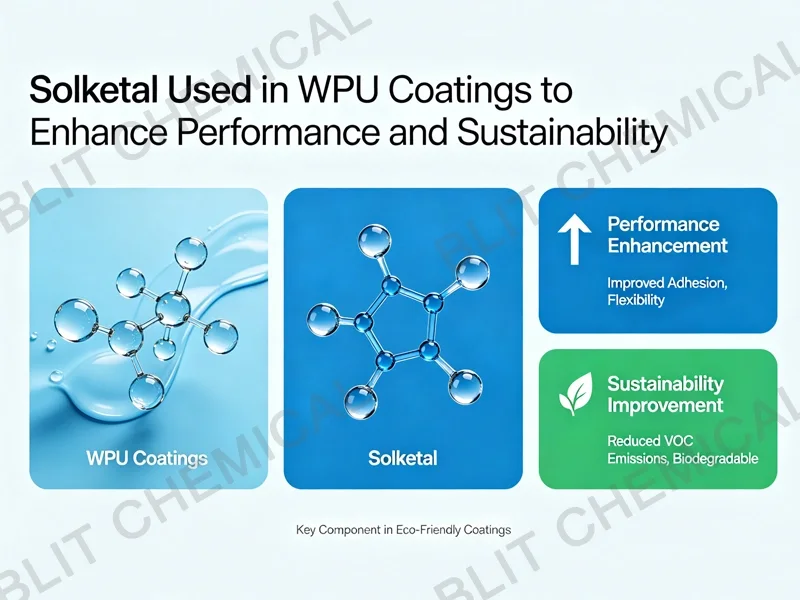
Solketal Used in WPU Coatings to Enhance Performance and Sustainability
Release time: 2026-05-06

Waterborne polyurethane (WPU) coatings are widely adopted as a lower-VOC alternative to solvent-based systems. They are used across wood coatings, industrial finishes, construction materials, and automotive applications.
However, when moving from solvent-based to waterborne systems, often encounter trade-offs—especially in mechanical strength, chemical resistance, and film quality.
One approach that has been gaining traction is the use of Solketal (2,2-Dimethyl-1,3-dioxolane-4-methanol) as a functional component in WPU formulations. Derived from glycerol, Solketal offers both formulation flexibility and a more sustainable raw material profile.
BLi-T (Hefei) Chemical Co., Ltd. provides Solketal for coatings and polymer applications, supporting manufacturers working on next-generation waterborne systems.
Where Traditional WPU Systems Fall Short
In practical applications, standard WPU formulations may show:
- Lower hardness compared with solvent-based polyurethane
- Limited resistance to solvents or aggressive environments
- Film defects related to leveling or drying behavior
These issues are not always critical in basic applications, but they become limiting in industrial or high-performance coatings.
How Solketal Works in WPU Formulations
Solketal can be introduced either as part of the polyol structure or as a co-solvent / formulation aid. Its contribution depends on how it is used, but several effects are consistently observed.
Strengthening the Polymer
When incorporated into the polymer backbone, Solketal contributes to a more compact structure.
Its cyclic acetal group helps:
- Improve hardness without making the film overly brittle
- Enhance abrasion resistance
- Increase adhesion on different substrates
This makes it particularly useful in coatings that require a balance between rigidity and flexibility.
Improving Film Formation and Application Behavior
In waterborne systems, film quality is often influenced by how well the resin disperses and coalesces.
Solketal, used as a co-solvent, can:
- Improve compatibility between components
- Support better wetting and leveling
- Reduce surface defects during drying
The result is typically a more uniform and visually consistent coating film.
Enhancing Chemical and Water Resistance
When chemically bonded into the polyurethane structure, Solketal can improve resistance to:
- Water exposure
- Organic solvents
- General chemical attack
This is especially relevant for coatings used in industrial or outdoor environments.
Supporting Bio-Based Formulation Strategies
BLiT chemical’s Solketal is produced from glycerol, which is commonly sourced from biomass.
For coating manufacturers, this offers:
- A route to reduce dependence on petrochemical raw materials
- Better alignment with environmental regulations
- Compatibility with low-VOC formulation targets
Rather than being a purely “green label” additive, it provides functional benefits alongside sustainability.
Comparison with Conventional Additives in WPU
Compared with traditional modifiers or solvents, Solketal is often selected when both performance improvement and environmental considerations are required.
It does not act as a direct one-to-one replacement, but rather as a formulation tool that helps optimize:
- Mechanical performance
- Application properties
- Environmental profile
Industrial Relevance and Supply
Solketal is typically produced via the condensation of glycerol and acetone under acid catalysis. With stable upstream availability of both raw materials, its industrial supply has become increasingly consistent.
Beyond coatings, it is also used in:
- Polymer synthesis
- Surfactants
- Pharmaceuticals
- Fuel additives
BLi-T (Hefei) Chemical Co., Ltd. offers Solketal with stable quality for industrial applications, including coatings and resin systems.
Prospects for Application in Water-based Coatings
As WPU coatings continue to replace solvent-based systems, the need for performance compensation becomes more important.
Solketal fits into this trend as a material that can:
- Improve formulation balance
- Support higher-end applications
- Contribute to more sustainable product design
Its role is likely to expand further as both regulatory pressure and performance expectations increase.
FAQs About Solketal in WPU Coatings
1. Is Solketal used as a solvent or a reactive material in WPU?
It can be used in both ways. In some formulations, it acts as a co-solvent to improve application properties, while in others it is incorporated into the polymer structure as part of the polyol component.
2. Does Solketal significantly change the formulation process?
In most cases, it can be integrated without major process changes. However, optimization of dosage and compatibility testing is recommended during formulation development.
3. What types of coatings benefit most from Solketal?
It is particularly useful in coatings requiring improved film quality, mechanical strength, and environmental compliance, such as industrial coatings, wood finishes, and protective systems.
Solketal offers a practical way to address some of the common limitations of waterborne polyurethane coatings. By improving mechanical properties, film formation, and resistance performance, it helps bridge the gap between environmental requirements and application demands.
To buy Solketal CAS 100-79-8 from manufacturer in China, BLIT Chemical offers competitive price with full product support, including specifications, MSDS, TDS, and COA. For factory-price Solketal, contact info@blitchem.com