


Disodium EDTA vs Tetrasodium EDTA: Differences, Applications & Supplier Guide
Release time: 2026-06-08
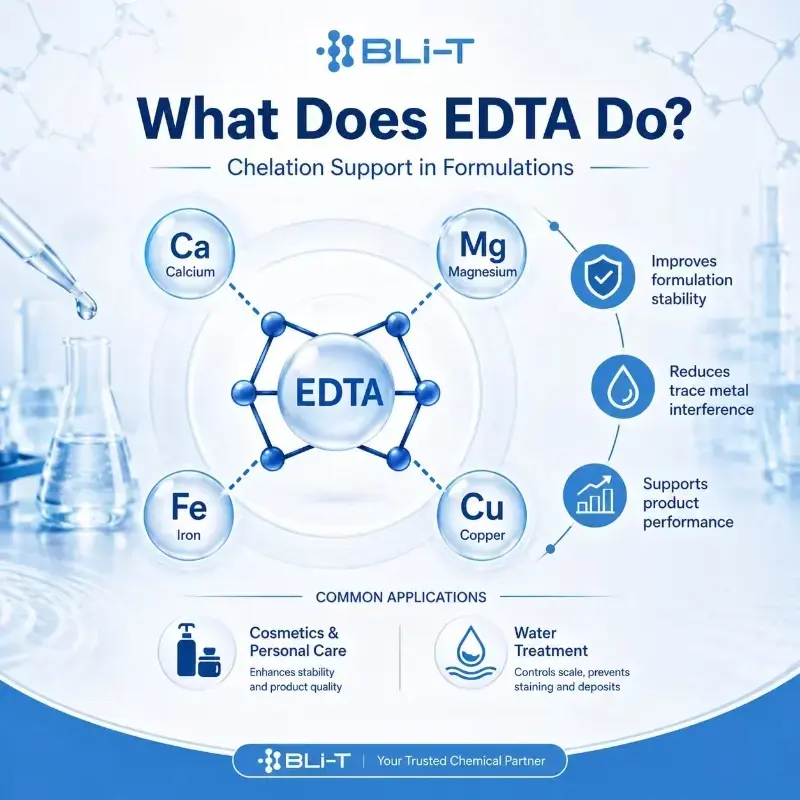
Disodium EDTA(EDTA 2Na,CAS 139-33-3) e Tetrasodium EDTA(EDTA 4Na,CAS 67401-50-7) are two commonly used EDTA chelating agents in cosmetic formulations, water treatment systems, detergents, cleaning products, and industrial applications. Both products help bind metal ions such as calcium, magnesium, iron, and copper, supporting better formulation stability and reducing the negative influence of trace metals.
However, Disodium EDTA and Tetrasodium EDTA are not the same. Their differences in sodium content, pH behavior, solubility, and application compatibility can affect product selection in real manufacturing conditions.
For cosmetic manufacturers, water treatment , detergent factories, and chemical distributors,etc., choosing the correct EDTA grade is important for formulation performance, quality control, and procurement efficiency.
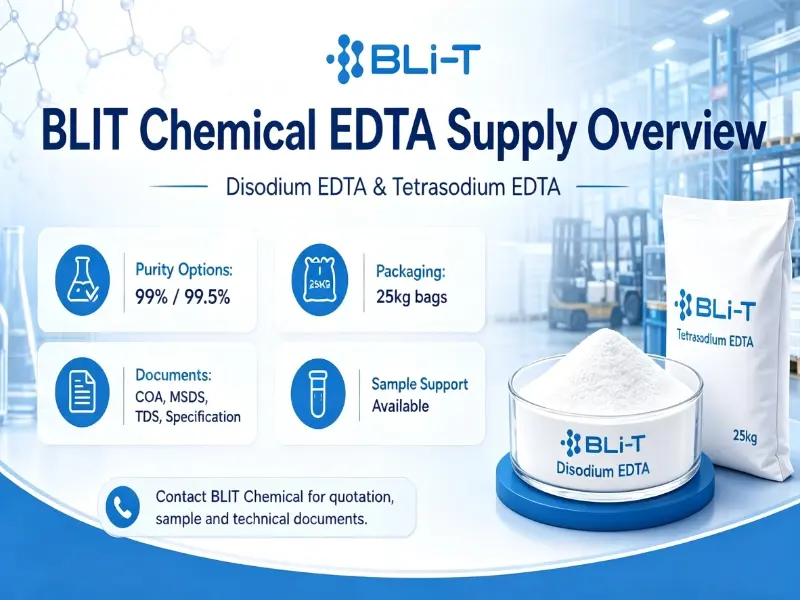
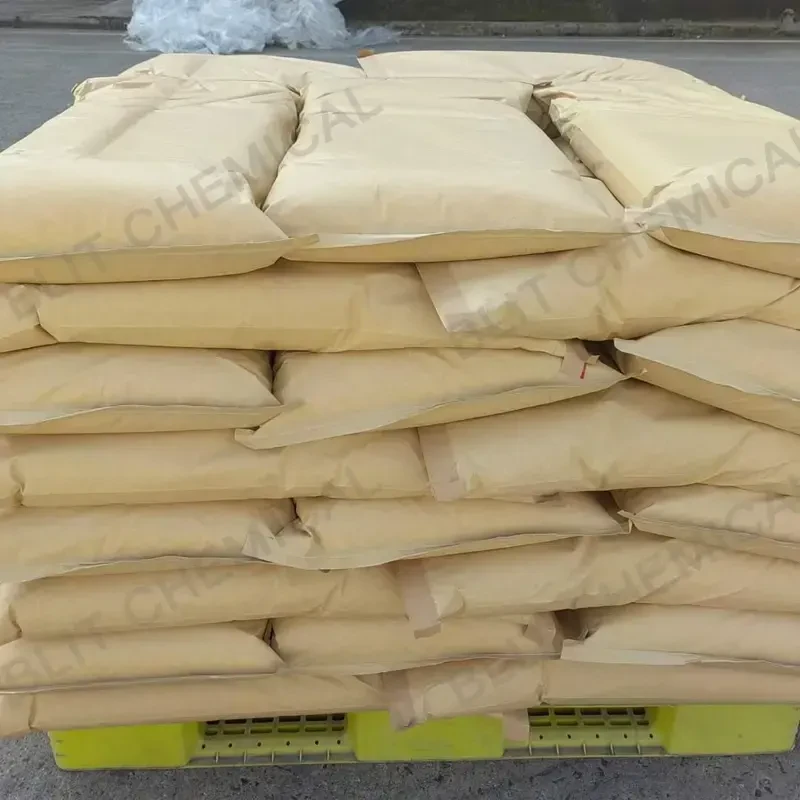
BLIT Chemical supplies Disodium EDTA and Tetrasodium EDTA with 99% and 99.5% purity options, 25kg bag packaging, and document support including COA, MSDS, TDS, Specification, and sample. For current price, sample availability, or technical documents, please contact BLIT Chemical for a quotation.
What are EDTA chelating agents?
EDTA, short for ethylenediaminetetraacetic acid, is a widely used chelating compound. EDTA salts can bind metal ions in aqueous systems and are commonly used to reduce the impact of water hardness and trace metal contamination in formulations. EDTA is used as a chelating agent to sequester metal ions that may be present in products.
In industrial and formulation use, EDTA is often supplied as different sodium salts, including Disodium EDTA and Tetrasodium EDTA. These salts are selected according to formulation pH, solubility requirements, processing conditions, and final application.
Common EDTA applications include:
– Cosmetic and personal care formulations
– Detergents and cleaning products
– Water treatment systems
– Textile and industrial processing
– Laboratory and chemical formulations
– Metal ion control in water-based systems
What is disodium EDTA?
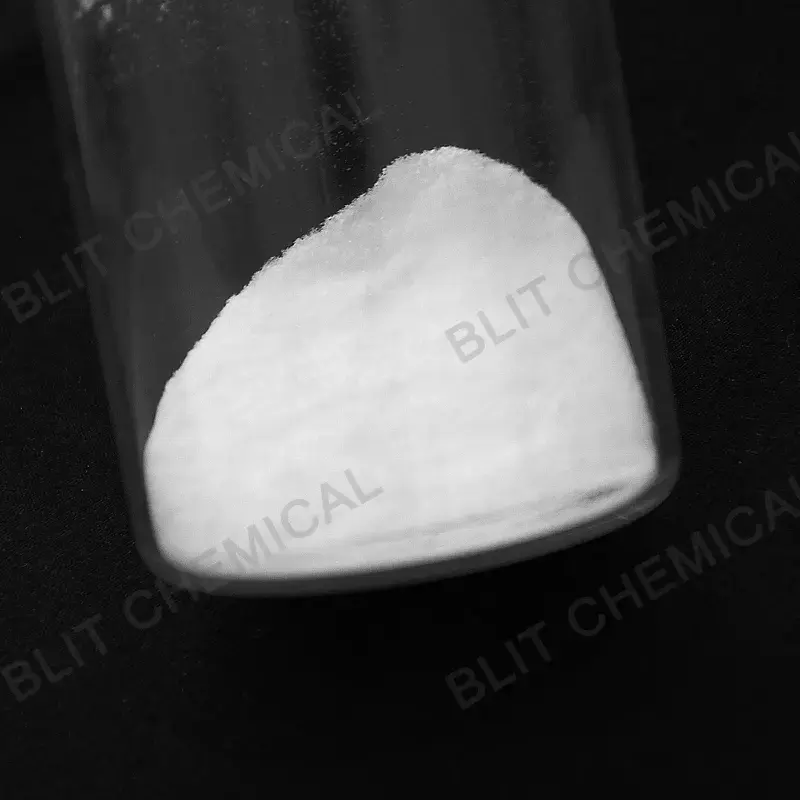
Disodium EDTA is the disodium salt form of EDTA. A common commercial form is Disodium EDTA Dihydrate, with CAS No. 6381-92-6. It is usually supplied as a white crystalline powder and is widely used in cosmetics, personal care products, cleaning products, water treatment, and industrial formulations.
Disodium EDTA is often selected for mildly acidic to neutral formulation systems. In cosmetic and personal care products, it is commonly used in creams, lotions, shampoos, facial cleansers, body wash, and hair care formulations.
For cosmetic manufacturers, Disodium EDTA can help reduce metal ion interference from water, raw materials, processing equipment, or packaging contact. This supports formulation consistency, appearance stability, and product quality control.
Typical Disodium EDTA Information
| Item | Informação |
| Nome do produto | Disodium EDTA |
| Other Name | EDTA-2Na / EDTA Disodium Salt |
| Common CAS No. | 6381-92-6 |
| Aparência | Pó cristalino branco |
| Typical Purity | 99% / 99.5% |
| Main Function | Chelating agent |
| Common Applications | Cosmetics, personal care, detergents, water treatment, industrial formulations |
| Embalagem | 25kg bag |
| Documentos | COA, MSDS, TDS, Specification |
| Sample | Available |
Looking for a Disodium EDTA supplier? BLIT Chemical can provide Disodium EDTA 99% and 99.5% with COA, MSDS, TDS, Specification, and sample support. Please contact us with your required purity, quantity, destination country, and application to request a quotation.
What is tetrasodium EDTA?
Tetrasodium EDTA is the tetrasodium salt form of EDTA. Common CAS numbers include 64-02-8 for anhydrous Tetrasodium EDTA and 10378-23-1 for certain hydrated commercial forms. Tetrasodium EDTA is a white solid and is highly soluble in water.
Compared with Disodium EDTA, Tetrasodium EDTA is more alkaline in aqueous solution. For example, supplier data for EDTA Tetrasodium Salt shows a pH range of 10.5–11.5 under specified testing conditions of 50 g/L in water at 20 °C.
Because of its alkaline behavior and good water solubility, Tetrasodium EDTA is often used in detergents, soaps, alkaline cleaners, water treatment chemicals, and industrial cleaning formulations.
Typical Tetrasodium EDTA Information
| Item | Informação |
| Nome do produto | Tetrasodium EDTA |
| Other Name | EDTA-4Na / EDTA Tetrasodium Salt |
| Common CAS No. | 64-02-8 / 10378-23-1 |
| Aparência | White powder or crystals |
| Typical Purity | 99% / 99.5% |
| Main Function | Chelating agent |
| Common Applications | Detergents, cleaners, water treatment, cosmetics, industrial formulations |
| Embalagem | 25kg bag |
| Documentos | COA, MSDS, TDS, Specification |
| Sample | Available |
Need Tetrasodium EDTA for detergent, cleaning, or water treatment applications? Contact BLIT Chemical to request Tetrasodium EDTA price, latest COA, MSDS, TDS, Specification, or sample for evaluation.
Disodium EDTA vs Tetrasodium EDTA: Key Differences
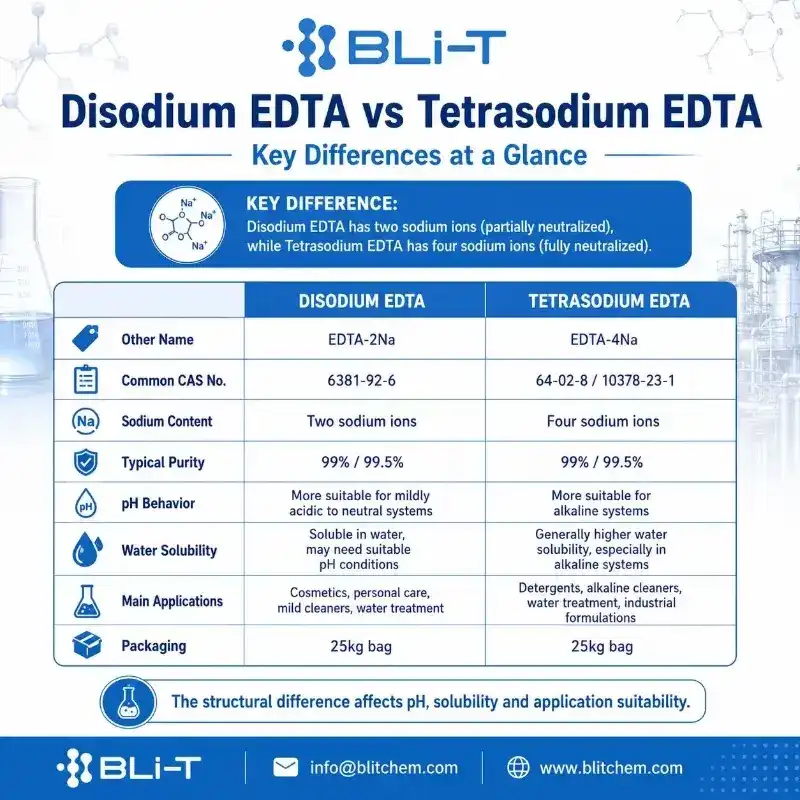
The main difference between Disodium EDTA and Tetrasodium EDTA is the degree of sodium neutralization. Tetrasodium EDTA is produced from the neutralization of EDTA with four equivalents of sodium base, while Disodium EDTA contains two sodium ions.
This structural difference affects pH, solubility, and application suitability.
| Item | Disodium EDTA | Tetrasodium EDTA |
| Common Name | Disodium EDTA | Tetrasodium EDTA |
| Other Name | EDTA-2Na | EDTA-4Na |
| Common CAS No. | 6381-92-6 | 64-02-8 / 10378-23-1 |
| Sodium Content | Two sodium ions | Four sodium ions |
| Typical Purity | 99% / 99.5% | 99% / 99.5% |
| pH Behavior | More suitable for mildly acidic to neutral systems | More suitable for alkaline systems |
| Solubilidade em água | Soluble in water, may need suitable pH conditions | Generally higher water solubility, especially in alkaline systems |
| Main Applications | Cosmetics, personal care, mild cleaners, water treatment | Detergents, alkaline cleaners, water treatment, industrial formulations |
| Embalagem | 25kg bag | 25kg bag |
For buyers comparing Disodium EDTA vs Tetrasodium EDTA, the key question is not only which product has stronger chelating ability, but which EDTA grade fits your formulation pH, product system, and procurement requirements.
Not sure which EDTA grade is suitable for your application? Send your formulation type, pH range, required purity, and target application to BLIT Chemical. Our team can help provide product selection support, COA, MSDS, TDS, and quotation information.
Difference in pH
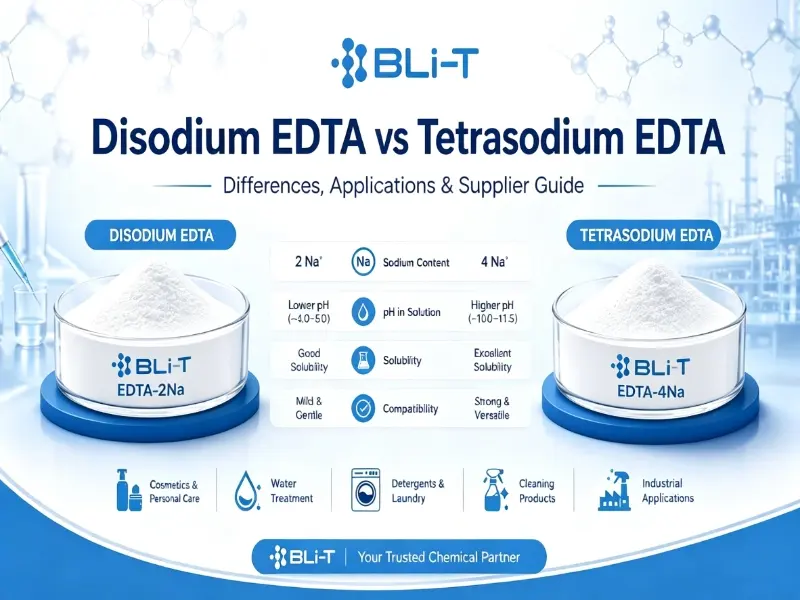
pH is one of the most important differences between Disodium EDTA and Tetrasodium EDTA.
Disodium EDTA is more suitable for mildly acidic to neutral systems. It is often used in cosmetic and personal care formulations where pH control is important.
Tetrasodium EDTA is more alkaline and is often used in alkaline systems such as soaps, detergents, hard surface cleaners, and certain water treatment applications. Tetrasodium EDTA supplier data commonly shows alkaline pH behavior in aqueous solution.
For formulators, this means Disodium EDTA and Tetrasodium EDTA should not be replaced directly without checking the final formulation pH.
Difference in solubility
Tetrasodium EDTA generally has better water solubility than Disodium EDTA, especially in alkaline systems. This makes it useful in liquid detergents, cleaners, and water treatment formulations where easy dissolution is important. Tetrasodium EDTA is described as highly soluble in water in chemical reference information.
Disodium EDTA can also be used in water-based formulations, but it may require proper processing conditions or pH adjustment depending on the formula.
In cosmetic production, Disodium EDTA is often dissolved in the water phase before emulsification or blending. In detergent or cleaning products, Tetrasodium EDTA may be easier to handle when the formula is already alkaline.
Difference in applications
Both Disodium EDTA and Tetrasodium EDTA can be used as chelating agents, but they are usually selected for different application systems.
| Aplicativo | Recommended EDTA Type | Reason |
| Cremes e loções | Disodium EDTA | Suitable for mildly acidic to neutral cosmetic systems |
| Shampoo and body wash | Disodium EDTA or Tetrasodium EDTA | Depends on final pH and formulation type |
| Soap-based cleanser | Tetrasodium EDTA | Better compatibility with alkaline systems |
| Liquid detergent | Tetrasodium EDTA | Good solubility and alkaline compatibility |
| Hard surface cleaner | Tetrasodium EDTA | Suitable for alkaline cleaning formulations |
| Water treatment | Disodium EDTA or Tetrasodium EDTA | Depends on water pH and metal ion control requirements |
| Industrial formulations | Both | Selection depends on process pH and application conditions |
In practice, the best EDTA choice depends on formulation pH, water quality, processing conditions, and customer specification requirements.
Applications of Disodium EDTA
Disodium EDTA is widely used in cosmetic and personal care formulations where metal ion control is required. It is commonly selected for mildly acidic to neutral systems, especially in products such as creams, lotions, shampoos, body wash, facial cleansers, and hair care formulations.
Disodium EDTA in Cosmetics and Personal Care
In cosmetic manufacturing, trace metal ions may come from water, raw materials, processing equipment, or packaging. These metal ions may affect product appearance, color, odor, stability, or preservative system performance.
Disodium EDTA helps bind these metal ions and reduce their influence in the formulation. It is commonly used in:
– Skin care formulations
– Creams and lotions
– Facial cleansers
– Shampoo and body wash
– Hair care products
– Hand wash
– Mild surfactant systems
For cosmetic manufacturers, Disodium EDTA is often a practical choice when the final product pH is mildly acidic to neutral.
BLIT Chemical supplies Disodium EDTA 99% and 99.5% for cosmetic manufacturers, personal care brands, and raw material distributors. Customers can request COA, MSDS, TDS, Specification, and sample before bulk order confirmation.
Disodium EDTA in Cleaning Products
Disodium EDTA may also be used in mild cleaning formulations where neutral or mildly acidic conditions are required. It can support metal ion control and help reduce the influence of hard water ions in water-based products.
Disodium EDTA in Water Treatment
In water treatment and industrial systems, Disodium EDTA may be used where controlled chelation is needed under neutral or mildly acidic conditions. Selection should be based on system pH, water quality, metal ion type, and process requirements.
For Disodium EDTA price, sample, or technical documents, please email BLIT Chemical with your required purity, quantity, destination port, and application.
Applications of Tetrasodium EDTA
Tetrasodium EDTA is commonly used in alkaline systems, especially detergents, soaps, hard surface cleaners, water treatment chemicals, and industrial formulations.
Tetrasodium EDTA in Detergents and Cleaners
For detergent and cleaning product manufacturers, Tetrasodium EDTA helps control hardness ions such as calcium and magnesium. This can support cleaning performance and formulation stability in water-based systems.
Tetrasodium EDTA is commonly used in:
– Liquid detergents
– Laundry detergents
– Hard surface cleaners
– Alkaline cleaning products
– Soap-based formulations
– Industrial cleaning formulations
– Textile processing systems
Tetrasodium EDTA is often preferred in alkaline products. Some cosmetic formulation suppliers also recommend Tetrasodium EDTA for alkaline products such as soap-based systems.
Looking for a Tetrasodium EDTA supplier? BLIT Chemical supplies Tetrasodium EDTA 99% and 99.5% in 25kg bag packaging. Contact us to request quotation, latest COA, MSDS, TDS, Specification, or sample for testing.
Tetrasodium EDTA in Water Treatment
In water treatment applications, Tetrasodium EDTA can help control metal ions and support system stability. It is often considered when the working environment is neutral to alkaline and good water solubility is required.
Water treatment formulators may choose Tetrasodium EDTA for:
– Metal ion control
– Hardness ion management
– Process water treatment
– Industrial water systems
– Cleaning and descaling-related formulations
Tetrasodium EDTA in Cosmetics
Tetrasodium EDTA can also be used in certain cosmetic and personal care systems, especially formulations with higher pH values. It may be suitable for soap-based cleansers, alkaline cleansing systems, and some surfactant-based products.
How to choose between disodium EDTA and tetrasodium EDTA
When choosing between Disodium EDTA and Tetrasodium EDTA, buyers and formulators should consider several practical factors.
Final Product pH
If the formulation is mildly acidic or neutral, Disodium EDTA is often more suitable. If the system is alkaline, Tetrasodium EDTA is usually a better option.
Solubility Requirement
For liquid detergents, alkaline cleaners, or water treatment systems requiring fast dissolution, Tetrasodium EDTA may offer better handling performance.
Application Industry
Cosmetic manufacturers often use Disodium EDTA in creams, lotions, shampoos, and skin care products. Water treatment formulators and detergent manufacturers may prefer Tetrasodium EDTA for alkaline systems.
Compatibilidade com outros ingredientes
EDTA selection should be checked together with surfactants, preservatives, pH adjusters, active ingredients, and other formulation components.
Required Specification
For B2B procurement, buyers usually need to confirm purity, appearance, pH, heavy metals, chloride, sulfate, packing, and available documents.
BLIT Chemical can provide Disodium EDTA and Tetrasodium EDTA specifications for customer evaluation. If you are not sure which grade to choose, please contact us with your application and target pH range.
Buy disodium EDTA or tetrasodium EDTA from BLIT chemical
When purchasing Disodium EDTA or Tetrasodium EDTA, buyers usually need to confirm product grade, purity, packaging, documentation, shipment arrangement, and application suitability.
BLIT Chemical supplies both EDTA products for global customers in cosmetics, water treatment, detergents, cleaning products, and industrial chemical markets.
| Supply Item | Available Information |
| Product | Disodium EDTA / Tetrasodium EDTA |
| Pureza | 99% / 99.5% |
| Embalagem | 25kg bag |
| Documentos | COA, MSDS, TDS, Specification |
| Sample | Available |
| Main Customers | Cosmetic manufacturers, water treatment formulators, detergent manufacturers, chemical distributors |
| Supply Market | Global |
Contact BLIT Chemical today to request EDTA price, sample, COA, MSDS, TDS, Specification, or technical support for your formulation.
Disodium EDTA vs tetrasodium EDTA: quick selection guide
| Buyer Requirement | Suggested Product |
| Cosmetic cream or lotion | Disodium EDTA |
| Mild facial cleanser | Disodium EDTA |
| Shampoo or body wash | Disodium EDTA or Tetrasodium EDTA, depending on pH |
| Soap-based product | Tetrasodium EDTA |
| Alkaline detergent | Tetrasodium EDTA |
| Hard surface cleaner | Tetrasodium EDTA |
| Water treatment formula | Depends on system pH |
| Higher water solubility requirement | Tetrasodium EDTA |
| Mildly acidic or neutral formulation | Disodium EDTA |
| Alkaline formulation | Tetrasodium EDTA |
This table is a general selection guide. Final product choice should be confirmed according to actual formulation pH, compatibility testing, and quality requirements.
Conclusão
Disodium EDTA and Tetrasodium EDTA are both important EDTA chelating agents, but they are suitable for different formulation systems.
Disodium EDTA is often used in mildly acidic to neutral cosmetic and personal care products, while Tetrasodium EDTA is commonly selected for alkaline detergents, cleaners, soaps, and water treatment applications.
For B2B buyers, the right choice depends on final product pH, solubility requirements, application industry, purity specification, and document requirements.
BLIT Chemical supplies Disodium EDTA and Tetrasodium EDTA 99% / 99.5% com 25kg bag packaging, sample support, and documents including COA, MSDS, TDS, and Specification.
If you are looking for a Disodium EDTA supplier or Tetrasodium EDTA supplier, please contact BLIT Chemical for quotation, sample, COA, MSDS, TDS, Specification, or product selection support.
Perguntas frequentes
What is the main difference between Disodium EDTA and Tetrasodium EDTA?
The main difference is sodium content and pH behavior. Disodium EDTA contains two sodium ions and is more suitable for mildly acidic to neutral formulations. Tetrasodium EDTA contains four sodium ions and is more alkaline, making it suitable for alkaline systems such as detergents, cleaners, soaps, and some water treatment applications.
What is the CAS number of Disodium EDTA?
A commonly used commercial form is Disodium EDTA Dihydrate, with CAS No. 6381-92-6.
What is the CAS number of Tetrasodium EDTA?
Common CAS numbers for Tetrasodium EDTA include 64-02-8 and 10378-23-1, depending on the anhydrous or hydrated form.
Can Disodium EDTA and Tetrasodium EDTA replace each other?
They are not always directly interchangeable. The selection depends on final product pH, solubility, formulation type, and application requirements. Testing is recommended before replacement.
Which EDTA is better for cosmetics?
Disodium EDTA is commonly used in creams, lotions, shampoos, cleansers, and other personal care products with mildly acidic to neutral pH. Tetrasodium EDTA may be used in higher-pH cosmetic systems such as soap-based cleansers.
Which EDTA is better for water treatment?
Both Disodium EDTA and Tetrasodium EDTA may be used in water treatment. Tetrasodium EDTA is often selected for neutral to alkaline systems where higher solubility and alkaline compatibility are required.
Which EDTA is better for detergents?
Tetrasodium EDTA is commonly used in detergents, alkaline cleaners, and soap-based products because of its alkaline compatibility and good water solubility.
Can I get a sample of Disodium EDTA or Tetrasodium EDTA?
Yes. BLIT Chemical can provide samples of Disodium EDTA and Tetrasodium EDTA for quality evaluation and formulation testing. Please contact us with your target application, required purity, and delivery information.
How can I get the latest Disodium EDTA or Tetrasodium EDTA price?
To request the latest price, please contact BLIT Chemical with the product name, purity, order quantity, destination country or port, and required documents. Our team will provide quotation support according to your requirements.
Does BLIT Chemical provide COA and MSDS?
Yes. BLIT Chemical can provide COA, MSDS, TDS, and Specification for Disodium EDTA and Tetrasodium EDTA according to customer requirements.
What packaging is available for EDTA products?
Standard packaging is 25kg bag. For bulk order or special shipping requirements, please contact BLIT Chemical before order confirmation.