



DEIPA vs TIPA vs EDIPA: How Cement Grinding Aid Manufacturers Select Alcohol Amine Raw Materials
Release time: 2026-08-12
DEIPA vs TIPA vs EDIPA, DEIPA, TIPA, EDIPA, cement grinding aid raw materials, alcohol amine for cement grinding aid, cement strength enhancer, cement additive raw material, DEIPA supplier, TIPA supplier, EDIPA supplier, cement grinding aid formulation
Why Alcohol Amines Matter in Cement Grinding Aid Formulation
For cement grinding aid manufacturers, alcohol amines are not selected only by price or active content. The more important question is whether the raw material can match the cement system, strength target, mineral admixture, grinding condition and final additive formulation.
DEIPA, TIPA and EDIPA are three commonly discussed alcohol amine raw materials in cement grinding aid and strength-enhancing systems. They can help improve cement grinding efficiency, support strength development at different ages and adjust the performance of blended cement systems. TIPA is also described by BASF as a grinding and dispersion aid for cement production, especially for high-quality cement types.
However, these three raw materials should not be treated as completely interchangeable. Their performance may vary according to clinker source, gypsum, cement type, slag powder, fly ash, limestone powder, grinding fineness and the complete grinding aid formulation.
BLIT Chemical supplies alcohol amine raw materials and cement additive solutions for cement grinding aid manufacturers, cement additive formulators and construction chemical companies. If you are comparing DEIPA, TIPA and EDIPA for your formulation, you can contact BLIT Chemical for sample evaluation and product selection discussion.
メールアドレス: info@blitchem.com
DEIPA, TIPA and EDIPA: What Is the Main Difference?
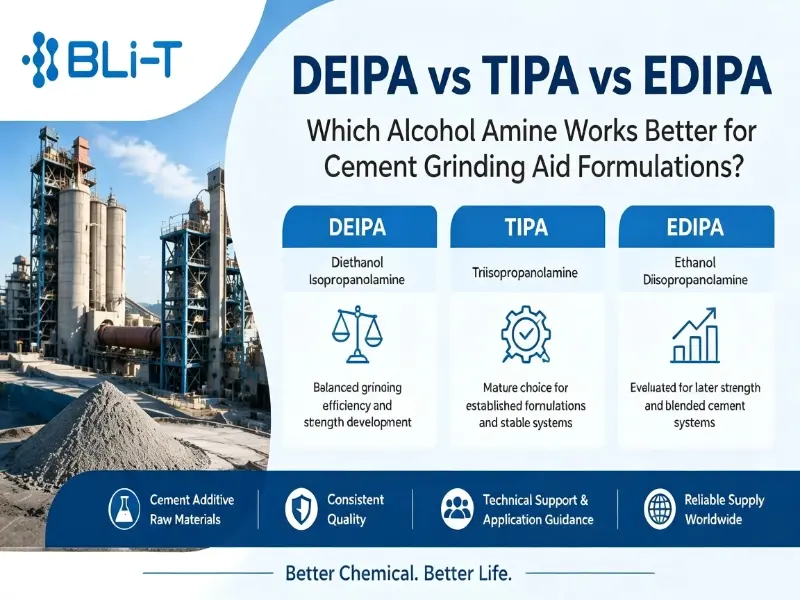
In cement grinding aid formulation, DEIPA, TIPA and EDIPA are usually compared by their influence on grinding efficiency, early strength, later strength and compatibility with blended cement materials.
| Raw Material | Full Name / Product Direction | General Selection Logic |
| DEIPA | Diethanol Isopropanolamine | Often selected for balanced strength enhancement and grinding aid formulation |
| TIPA | Triisopropanolamine | Commonly used in mature cement grinding and dispersion systems |
| EDIPA | Ethanol Diisopropanolamine | Often evaluated for later strength development and blended cement activity |
Research literature describes DEIPA as a tertiary alkanolamine used in cement grinding aid additives and concrete early-strength agents. Studies also discuss DEIPA and EDIPA as newer alkanolamines used in grinding aids or accelerators, with performance depending on cement hydration and cement-blend composition.
From previous BLIT Chemical product writing materials, EDIPA was also positioned as a newer cement grinding aid raw material that can be used to replace TIPA in some formulations. Compared with DEIPA, EDIPA may show slightly lower early strength growth but stronger later strength potential, and it can help stimulate the activity of blended materials such as fly ash, slag powder and limestone powder in certain cement systems.
For buyers, the key point is simple: do not select DEIPA, TIPA or EDIPA only by name. The right choice depends on the cement system and the strength target.
When Should Cement Grinding Aid Manufacturers Choose DEIPA?
DEIPA is often considered when manufacturers want a raw material that supports both grinding aid formulation and strength development. It is widely evaluated in cement systems where customers need a balance between early strength, later strength and formulation cost.
DEIPA may be suitable when the buyer needs:
- Better balance between grinding efficiency and strength enhancement
- Support for different cement ages rather than only one strength point
- A raw material for general cement grinding aid formulation
- Compatibility with Portland cement, ordinary Portland cement and composite cement systems
For many cement additive manufacturers, DEIPA is not used alone. It is often adjusted together with polyhydroxy compounds, glycols, salts or other functional components in the final grinding aid formula.
BLIT Chemical’s cement additive product experience allows us to understand DEIPA not only as a chemical raw material, but also as part of a downstream cement grinding aid system.
When Should Buyers Choose TIPA?
TIPA is a mature alcohol amine used in cement grinding and dispersion systems. For customers with existing grinding aid formulas, TIPA is often considered when the formulation has already been tested and the customer wants a stable raw material option.
TIPA may be suitable when:
- The customer has an existing mature grinding aid formulation
- The cement plant already has performance data based on TIPA
- The buyer needs a familiar alcohol amine for cement grinding systems
- The formula focuses on stable grinding and strength support in known cement conditions
Because TIPA is already widely recognized in cement additives, many buyers use it as a reference point when comparing DEIPA or EDIPA.
However, when cement producers increase blended materials or adjust clinker ratio, TIPA may not always be the most cost-effective option. In this case, DEIPA or EDIPA can be tested as alternatives or combined options.
When Should Buyers Evaluate EDIPA?
EDIPA is often evaluated when customers need later strength development, blended cement activity or a newer alcohol amine structure for cement grinding aid formulation.
According to previous BLIT Chemical product writing notes, EDIPA combines certain advantages of TEA and TIPA and can be used in cement grinding aid systems. It differs from DEIPA in that early strength growth may be slightly lower, while later strength growth can be stronger in some cement systems. It may also help stimulate the activity of fly ash, slag powder and limestone powder.
EDIPA may be suitable when:
- The cement system contains fly ash, slag powder or limestone powder
- The buyer focuses on later strength improvement
- The customer wants to reduce clinker ratio while maintaining cement performance
- The grinding aid manufacturer is developing a new formula instead of simply copying an old TIPA system
- The cement type includes composite Portland cement, slag cement or blended cement
Actual performance should always be tested according to clinker source, cement type, mineral admixture, grinding condition and final formulation.
How to Select the Right Alcohol Amine for Different Cement Systems
There is no single alcohol amine that fits every cement system. Cement grinding aid manufacturers usually need to match raw materials according to cement type and performance target.
| Buyer Requirement | Suggested Evaluation Direction |
| General grinding aid formulation | Evaluate DEIPA or TIPA |
| Mature formula based on existing market practice | TIPA can be used as a reference option |
| Balanced early and later strength | DEIPA is often worth testing |
| Later strength improvement | EDIPA can be evaluated |
| Cement with fly ash, slag or limestone powder | EDIPA or DEIPA may be tested based on formula design |
| Need to adjust cost-performance balance | Compare DEIPA, TIPA and EDIPA through cement testing |
| New cement additive development | Test multiple alcohol amines with local cement materials |
In real production, the same alcohol amine may show different performance in different cement plants. This is why cement additive manufacturers usually run laboratory grinding tests and mortar strength tests before bulk procurement.
A practical evaluation should include:
- Clinker source
- Cement type
- Gypsum adjustment
- Mineral admixture ratio
- Grinding fineness
- Grinding aid dosage
- 3-day, 7-day and 28-day strength data
- Compatibility with water reducer or concrete admixture system
The goal is not to find the “strongest” alcohol amine in theory, but to select the raw material that gives stable performance in the customer’s actual cement system.
What Buyers Should Check Before Purchasing DEIPA, TIPA or EDIPA
For cement grinding aid manufacturers, alcohol amine procurement should focus on both technical performance and supplier capability.
Before purchasing DEIPA, TIPA or EDIPA, buyers should confirm:
- Product name and active content
- Color and appearance
- Amine composition and impurity control
- Primary/secondary amine and amine ether content
- Batch consistency
- Packaging and storage condition
- Sample availability
- COA, MSDS, TDS and Specification support
- Whether the supplier understands cement grinding aid formulation, not only chemical trading
For alcohol amine raw materials, small impurity differences may influence odor, color, formulation stability and cement additive performance. Therefore, many customers prefer suppliers who can support both raw material supply and cement additive application discussion.
BLIT Chemical’s alcohol amine products are produced using self-owned patented technology, with low primary/secondary amine and amine ether content. The products are designed to support better strength-enhancing performance in cement grinding aid systems.
BLIT Chemical Supply Support for Cement Additive Manufacturers
For cement grinding aid manufacturers, choosing an alcohol amine supplier is not only about buying DEIPA, TIPA or EDIPA. A stronger supplier should understand cement additive formulation, raw material consistency, downstream cement performance and long-term supply.
BLIT Chemical focuses on the R&D, production and service of cement additives, concrete admixtures and epoxy-derivative fine chemicals. The company has built an integrated industrial chain from raw materials to finished products, covering polyether monomers, alcohol amines, mother liquor, cement additives and concrete admixtures.
Across related product lines, the production capacity has reached more than 2 million tons, supporting large-scale raw material supply and finished additive production.
BLIT Chemical’s alcohol amine product portfolio includes:
| Product | Product Code | Application Direction |
| Triethanolamine | BLA-TA | Cement additive raw material |
| Triisopropanolamine | BLA-TI | Cement grinding and dispersion aid systems |
| Diethanol Monoisopropanolamine | BLA-DI | Cement grinding aid and strength-enhancing systems |
| Ethanol Diisopropanolamine | BLA-EI | New-generation grinding aid and strength-enhancing formulation |
These alcohol amines are suitable for Portland cement, ordinary Portland cement, composite Portland cement and slag Portland cement systems, depending on formulation testing and cement material conditions.
In addition to alcohol amine raw materials, BLIT Chemical also produces cement additive products composed of polyhydroxy organic compounds and alkanolamines. These products are used in cement grinding, strength enhancement, flowability improvement and compatibility adjustment between cement and water reducers.
The cement additive product portfolio includes:
| Product | Product Code | Application Direction |
| General cement grinding aid | BLA-GO | General cement grinding process |
| Hexavalent chromium reducer | BLA-FHO | Chromium reduction in cement production |
| High-alkali cement additive | BLA-FHA | High-alkali cement systems |
| Vertical mill cement additive | BLA-FVM | Cement vertical mill systems |
| Slag powder additive | BLA-FMP | Slag powder grinding and activation |
| Limestone powder additive | BLA-FLS | Limestone powder cement systems |
This product structure allows BLIT Chemical to support customers from raw material selection to finished cement additive formulation.
BLIT Chemical has also built application experience with leading cement producers, construction material groups and cement additive manufacturers in China and overseas markets, including Southeast Asia and Central Asia. This helps the company better understand the differences between cement systems, mineral admixtures and regional grinding aid requirements.
For DEIPA, TIPA, EDIPA or finished cement additive product discussion, please contact BLIT Chemical at info@blitchem.com .
Contact BLIT Chemical for Alcohol Amine Raw Material Selection
Some customers already know which alcohol amine they need. They may request DEIPA for a balanced grinding aid formula, TIPA for an existing mature formula, or EDIPA for later strength and blended cement systems.
Other customers are still comparing DEIPA, TIPA and EDIPA because their cement plant uses different clinker, slag, fly ash or limestone powder. Both situations are common.
If you are not sure which raw material is suitable, you can send your cement type, additive formulation direction, target strength requirement, mineral admixture ratio and expected order quantity to BLIT Chemical. Our team can help review whether DEIPA, TIPA, EDIPA or a finished cement additive solution is more suitable for your application.
メールアドレス: info@blitchem.com
DEIPA, TIPA and EDIPA are all important alcohol amine raw materials for cement grinding aid and strength-enhancing formulations, but they should not be selected only by price or product name.
For general cement grinding aid formulation, DEIPA and TIPA are often evaluated first. For later strength development and blended cement systems containing fly ash, slag powder or limestone powder, EDIPA can be an important option. The final selection should be based on clinker source, cement type, mineral admixture, grinding condition and strength test results.
BLIT Chemical supports cement grinding aid manufacturers with alcohol amine raw materials, finished cement additive products, integrated production capacity and application experience in cement systems.
For DEIPA, TIPA, EDIPA, cement grinding aid raw materials or finished cement additive solutions, please contact BLIT Chemical.
メールアドレス: info@blitchem.com
よくある質問
What is the difference between DEIPA, TIPA and EDIPA in cement grinding aids?
DEIPA is often evaluated for balanced early and later strength support. TIPA is a mature alcohol amine used in cement grinding and dispersion systems. EDIPA is often evaluated for later strength development and blended cement systems containing fly ash, slag powder or limestone powder.
Which alcohol amine is better for early strength?
DEIPA is often tested when customers need balanced strength development, including early strength. However, actual results depend on clinker, cement type, gypsum, mineral admixture and grinding aid formulation.
Which alcohol amine is better for later strength?
EDIPA is often evaluated when the customer focuses on later strength or blended cement activity. In some systems, it may show stronger later strength potential than DEIPA, but testing is still required.
Can EDIPA replace TIPA in cement grinding aids?
EDIPA can be evaluated as an alternative to TIPA in some cement grinding aid systems, especially when later strength or mineral admixture activation is important. It should be tested based on the customer’s actual cement system.
Does BLIT Chemical supply finished cement grinding aid products?
Yes. In addition to alcohol amine raw materials, BLIT Chemical supplies cement additive products such as general cement grinding aid, high-alkali cement additive, vertical mill cement additive, slag powder additive and limestone powder additive.
What information should I provide for alcohol amine quotation?
Customers can provide product name, required quantity, target application, cement type, mineral admixture ratio, packaging requirement and destination country. If the customer is not sure which alcohol amine to choose, BLIT Chemical can help review the application direction.